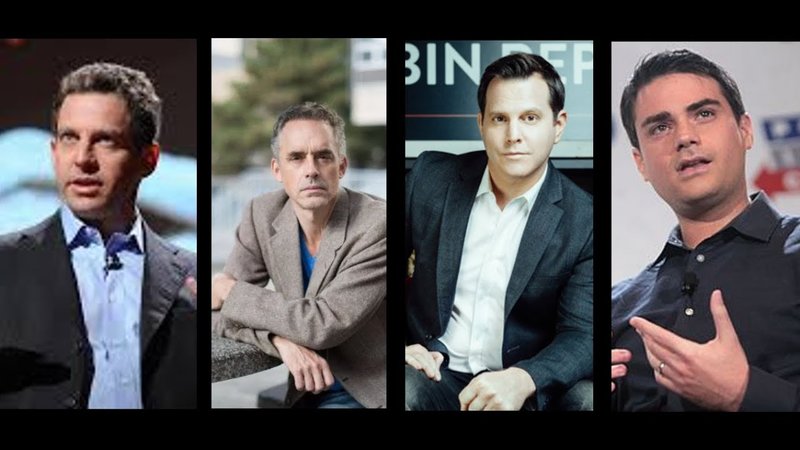
Most simply, it is a collection of iconoclastic thinkers, academic renegades and media personalities who are having a rolling conversation — on podcasts, YouTube and Twitter, and in sold-out auditoriums — that sound unlike anything else happening, at least publicly, in the culture right now. Feeling largely locked out of legacy outlets, they are rapidly building their own mass media channels. Douglas Murray has been fighting with Joe Rogan and comedian Dave Smith over Palestine and Second World War revisionism.
If conservatism is to survive, let alone flourish, then we have a simple choice to make. We must embrace the principles that gave rise to the intellectual dark web and dump, once and for all, the principle-free world of the unintellectual dark web that values nothing but clicks and cash. This thirst explains how Carlson dismissed those caring about Oct. 7 as being obsessed with “foreign” matters before traveling to what seems like every country in the world to extol their virtues, fictional or otherwise. This thirst explains how Johnson, a Christian husband and father, embraced and emulated Andrew Tate, a Muslim pimp and self-professed abuser of women, before defending himself by misappropriating a Bible verse. This thirst explains how Candace Owens went from being an immovable supporter of Israel to one of its most enthusiastic (and spectacularly ignorant) critics seemingly overnight, regurgitating the same antisemitic Wikipedia articles that were available while she was flying to Israel to celebrate the opening of the U.S. Bari Weiss profiles the “Intellectual Dark Web,” (I.D.W.) a group of loosely-connected thinkers that are getting more attention than ever before in our fraught era of discourse.
“Strange how we once thought that the purpose of academics was to put forward bold ideas for the greater good of society,” Roberts told me. “Now the purpose of academia is for pseudointellectuals to trade fashionable lies so that they can build their pseudo careers.” I’m one of those who, unrepentantly and unapologetically, praise Joe Rogan. In particular, I like the fact that he is willing to tackle controversial topics. He gives a platform to new, unconventional science and technology that the public is not yet aware of. For example, Rogan has recently interviewed maverick scientists Sonny White and Hal Puthoff on his extremely popular podcast. I think Rogan’s podcast is a very useful source of scientific information.
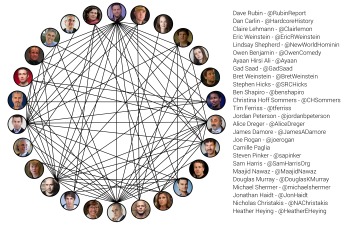
Alternative Sense-making Collective
It was in a flurry of reports over such campus controversies that Richard Bernstein helped popularize the term “political correctness” as we know it today. Recognizing that these dark web ideas are conservative might also help clear up space for people on the left of center who might share some criticisms of political correctness or campus activism without indulging the right-wing implications of these ideas. Many people across the political spectrum recognize that political correctness and its variants are not meaningless terms. It is no surprise that college students often experiment with activist projects that push the boundaries of liberal norms, and the members of the intellectual dark web are not the only people to have worried about the implications of some student rhetoric.
New York Times Op-ed
The Intellectual Dark Web exists because many still venerate objective truth. With the rules of truth-proving being rewritten by our institutions, many expelled thinkers continue their pursuit online. It’s a blessing for those who want to have discussions on evolutionary biology, religion, culture, economics, and politics, without any toxic ideology polluting the outlet. We have started concentrating the power of who determines truth in the hands of educational administrators, politicians, and bureaucracies.

My Book On The Intellectual Dark Web Was “Cancelled”
After a failed trial run in 1976 Republican against then-president Gerald Ford, Reagan won the party nomination and the presidency in 1980 and again in 1984. Likewise, it’s unclear that Weiss and her predecessor, James Atlas, were aware that they were being used in a process that had already repeated itself several times before the late nineties. As for the larger group, conspiracy theorizing was always a key plank in the Intellectual Dark Web’s branding (I mean, just say the name out loud and you’ll sound like you need to go touch some grass).
What Was The Intellectual Dark Web?
Having failed once again to mask reactionary ideas in moderate-sounding language, the right wing’s lavishly funded marketing firms are surely hard at work trying to devise a replacement for the IDW. And if past is predicate, the only thing in doubt is who will be the New York Times’s next leopard-print cover model. Like nearly all libertarians, the members of the IDW were insistent that they were not just Republicans with an accent, and that in fact, they were actually leftists. Twenty-nine years after Laura Ingraham was the Times’s cover model, no one imagines that she is anything but a conventional Republican talking head. Likewise, as my friend Eiynah Mohammed-Smith and I discussed recently on her podcast, nearly everyone profiled by Weiss has dropped the pretense of being anything other than right-wing. The financial and foreign policy disasters brought on by Bush’s policies led the public to overwhelmingly reject Republicans in 2008 as the first-term Democratic Sen. Barack Obama swept into the White House.
The Intellectual Dark Web: A History (And Possible Future) By Jamie Q Roberts
What is apparently so novel about the “intellectual dark web” is not just its savvy use of Patreon or YouTube, but its claim to be eclectic and transpartisan. It has become typical for the members of this club when they appear in public — on Harris’s or Joe Rogan’s podcasts, for example, or on Peterson’s and Dave Rubin’s YouTube channels — to stress emphatically both their ideological divides and their respect for the intellectual virtues that they believe allow them to overcome them. The main attraction of Harris and Shapiro’s conversation was not their philosophical sparring, but their show of solidarity against the left-wingers that had attacked them both. In the face of the politically correct left, and to a lesser extent the neo-fascist alt-right, these thinkers aim to present themselves as defenders of “reason,” “truth,” and “facts.” This attachment to rational principles — not to parties or tribes — leads them at times to characterize themselves as a new political center. The intellectual dark web does not only recycle conservative theories explaining our supposed wave of left-wing irrationalism. The ideas they claim to defend from politically correct opponents of truth are themselves a longstanding part of the United States’s conservative tradition.

China’s Intellectual Dark Web
Humility it turns out, was not exactly the strong suit of the denizens of the IDW and it showed. When I first decided to write a book about the IDW, I knew I didn’t want to write a “scholarly” work. In the spirit of the IDW, I wanted the book to be accessible to a wide audience. But I also knew that engaging with “scholarship” would likely weaken the book. Don’t get me wrong, I admire the punctilious efforts of genuine historians, archaeologists, political scientists, and so on.
Published
- The same is true for men who call for women who have had abortions to be hanged by the neck until dead.
- Part of the search for truth should be a search for what could be called political moral truth, simply the way to say something that is both true and helpful.
- George H.W. Bush’s attempt to present a “kinder and gentler” America in 1988 faced challenges from within the party, but he was able to preserve the last shred of Reagan’s brand to win the presidency on his own.
- Employing it as his basic framework throughout, Brooks devotes the lion’s share of Against the Web to intellectually satisfying deconstructions of the group’s leading figures and their essentially mythical narratives.
- Douglas Murray has been fighting with Joe Rogan and comedian Dave Smith over Palestine and Second World War revisionism.
But only one cheer, because he’s still letting some mortifying IDWers off the hook for behavior he’s decried in others, and he hasn’t yet truly reflected on why he was so taken in by dim careerists and a movement built more on emotional opposition to wokeness than a noble pursuit of truth and vigorous debate. It’s frustrating (and sometimes even embarrassing) when your judgment fails you in assessing a person, be it in a personal or professional relationship. Rubin has frequently said that his political “awakening” (or why he “left the left”) was inspired by watching Harris and Ben Affleck argue about Islam on an episode of Real Time with Bill Maher. Harris was subsequently the first guest on Rubin’s rebooted YouTube show. In short, Rubin’s origin story as a “public intellectual” is inextricably linked to Harris.
The intellectual dark web appears with each passing day to be earning itself a place in the American conservative tradition. The fact that many of these figures have no links to the conservative movement or denounce the Republican Party is hardly evidence to the contrary. Allan Bloom was a member of the Democratic Party, and the campus war debates he helped to start provided the opportunity for many younger writers to gain national notoriety as conservatives for the first time. Despite some of the novelty attributed to the dark web intellectuals, perhaps the signs of their belonging to the right have always been there. Dave Rubin’s YouTube show and Harris’s podcast, for example, have featured a number of mainstays of the old PC debates, including D’Souza and Charles Murray.
Fellaheen is not an ethnic identity, so they are simply slaves laboring under imperial bureaucracy. Also, he supports the idea of “various Chinese nations,” so in Sichuan, there’s a Basuria, in Hubei a Jingchuria, in Guangdong a Cantonia… It’s ridiculous, isn’t it? This is a massive simplification, trimming Liu’s ragged bush of fascist historiography, Christian millenarianism, conspiracy theory, and anti-left extremism into a tidy landing strip.
An Autopsy Of What Was Once Called The Intellectual Dark Web
I found a downloadable PDF copy of the book while searching for something else. Then I wanted to buy a Kindle edition, but the Kindle edition never came out. I found this surprising but now, after a conversation with the author, I know what happened.